Friday, February 3, 2012

Front Page News Story

Qin Starts Building Protection Wall
By Tyler Gardiner
Qin Dynasty Dedication
221 BCE


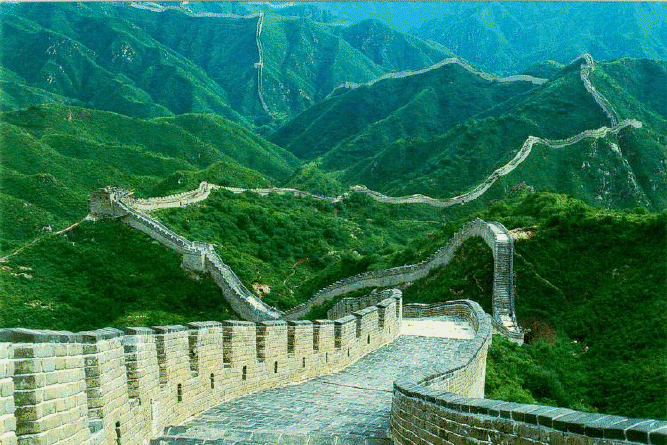
Liaodong - Emperor Qin has declared that a wall will be built near the town of Liaodong. This wall will be made because of the invaders that are trying to take over our land. Our neighboring territories are trying to gain our land and control us. We have won previous battles, but how long can we last if we keep losing men? That’s the point of building the Wall.

Emperor Qin is a Legalist believer. He is the first emperor China has ever had. He has been a great leader putting the peoples protection first. He has made a strong army, and the first army, to protect our territory and keep his people safe.

Natives that live around the area don’t really like the idea of a wall. We interview an anonymous person about the wall and they said, “The wall is right in the middle of our herding land. We take our sheep up to the mountain to eat. With the wall, our sheep have no way to get up to the food they need.” It’s not just this person who thinks the wall is a bad idea. Many people that are living near the wall are complaining that the wall is a bad idea.

But, not everybody is disappointed by the wall. Manchu Li, a pottery maker, is going to work on the wall. “The wall is a great way to protect the citizens of an upcoming China. It will block out invaders and give us an upper hand on the enemy.” According to Qin, the wall will protect our crops, and the people of China. Qin thinks this is a great add to the Qin Dynasty, and will give the people great protection.


Qin Dynasty Editorial

Qin Simplifies Systems

Emperor Qin has simplified the many systems that we have to one that we can all understand. He standardized the weights, measurements, currency, language, and writing systems. This will make it easier for people from other territories that used to have different systems to communicate using the same language.
           
People from other territories in China have a hard time talking to each other because they don’t speak the same language. Trading is difficult because the measuring systems vary between people. Other territories will now be able to talk to each other when trading or just talking in normal everyday life. This will enhance trading because everyone is talking about the same things. For instance, if you are going to trade 1 ounce of something for another ounce of something else, you are getting the same amount and not being ripped off because you are both using the same measuring systems. Another example is that you are able to talk to each other because you are speaking the same language. It won’t matter where you are from because now everybody is using the same thing.
           
But, with the new systems everybody is getting confused. They are saying, “There are no positive results with the new systems”. People are also saying, “Everybody will have to learn new systems that they have grown up with all their life.” Even though you have to learn something new, it’s a really easy system to know and can only move China forward. You will be able to talk to people you haven’t been able to talk to because you are speaking different languages. This makes communication easier because you can make more friends, trade easily, and make connections to many people in different parts of China.
           
This is a big step for China. China is moving forward in society, and Qin believes this will help China improve. This should make everyday life easier for people that didn’t used to speak the same languages. But, China will always test new ideas to help the people live easier lives.

Map Of The Qin Dynasty


The Qin Dynasty was the first dynasty (221 - 206 BCE) to unite China into one country. Qin controlled most of the eastern border of modern day China. The red and white territory is what Qin controlled and the outline in black is modern day China. The northern border was protected by what is now the Great Wall of China. The border expanded as high as the Huang He, and as low as what is now Vietnam. On the eastern border is what is now called the East China Sea and the Yellow Sea. Qin used China’s first military to conquer new land and expand the area of China. The capital was Xianyang as compared to the modern day capital of Beijing. Before the Qin Dynasty was the Warring States Period. This was when China wasn’t a united nation and all the states would fight for themselves and against each other for land and resources. The map above was split into many different territories. The country didn’t extend as far south or north as the Qin Dynasty does. This is because the States spent more time fighting each other rather than trying to get new land.

A Famous Invention During The Qin Dynasty

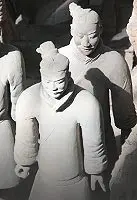
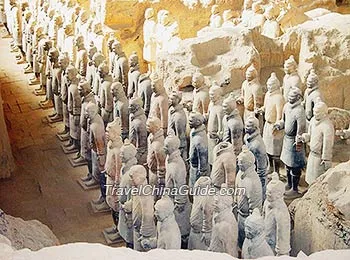
A famous invention made during the Qin dynasty was the Terracotta Army. Qin made life size figures of every person in his army. It was an exact replica of what the person looked like when they were living. Qin buried his army in his tomb when he was buried, probably to have his army with him in the afterlife. It took years to build all of the figures, because they were modeled after actual army memebers and had a lot of detail in them. But it wasn’t just soldiers made. Other profession where also made. This magnificent creation was just found by a couple of farmers that were trying to dig a well in 1974.

The terracotta army was made throughout Qin Shi Huang Di’s life. It was probably started around 221 BCE because that’s when he started his reign of China’s first emperor. We don’t think it was intended to be used in this life, but in the afterlife. Historians believe that the models of people were supposed to be carried over into the afterlife so he can continue his conquest. Weapons such as swords, spears, axes, shields, crossbows, arrows were also found in the hands of warriors that fought for Qin.

Qin’s tomb changed people lives because it took years to build. It took his whole time as the emperor and alittle bit after to put the whole thing together. A lot of man power was used to dig, put everything together, and decorate everything perfectly. People even died building the tomb.

The terracotta army gave historians inside looks on the past. Qin made exact replicas of people, animals, and things used during everyday life. It is used in museums and is being studied by historians. Other parts of Qin’s tomb have yet to be discovered because we if we try to get into the parts, the air could destroy it or the sides could collapse in and then we wouldn’t know what was in there or what it was supposed to look like.


Interview With Qin Shi Huang Di

Q: How do you feel now that you have united China into one country?
A: Now that China is a united country, I feel honored because I am the first person to have China as one. We will fight as one, win as one, and lose as one. We will fight for each other in order to show our loyalty to China!

Q: What form of government do you believe in?
A: As a kid, I was punished a lot. I believe that punishing people is the way to have a loyal and obedient society. Legalism is based on the ideas of Han Fei. Han Fei believed that most people are naturally evil and selfish. Clear punishments and rewards will make the society obey what is supposed to happen in a Legalist world.

Q: What clear punishments and rewards do you give to the people?
A: If someone is bad and worthy of a punishment they could be sent to the northern end of China, their hands could be chopped off, they could be burned alive or boiled to death in pots. But if someone is worthy of a reward they could be given the day off from daily activities, promotions, or get to marry the girl of their choice.

Q: What are your plans for your tomb when you die?
A: I am in the middle of creating a potion that will allow me to live forever. But, if that doesn’t work I am making exact replicas of members of my army. They are being made of terracotta. They will be buried along with many pottery items, weapons, and other important things to me. Warriors with chariots and horses will be made and placed into my tomb.

Q: What’s your reason for building a wall?
A: I am building a wall because invaders from the north keep taking our crops, taking our land and killing our people. I have to defend our people, so I created China’s first united military. This will hopefully keep the invaders out and protect the people of China. If the enemy took over our country we would suffer because they are all shallow and selfish.

Bibliography


Works Cited
The British Museum. Ancient China - British Museum. N.p., n.d. Web. 25 Jan. 2012. <http://www.ancientchina.co.uk/‌menu.html>.
- - -. “Qin Dynasty.” Ancient China. The British Museum, n.d. Web. 23 Jan. 2012. <http://ancientchina.co.uk/‌staff/‌resources/‌background/‌bg6/‌home.html>.
Chinese Dynasties. N.p., n.d. Web. 23 Jan. 2012. <http://library.thinkquest.org/‌12255/‌library/‌dynasty/‌dynasty.htm>.
Great Wall Of China. N.d. N.p., n.d. Web. 6 Feb. 2012. <http://www.crystalinks.com/‌chinawallarge.gif>.
Great Wall Of China. N.d. N.p., n.d. Web. 6 Feb. 2012. <http://bookitnow.com/‌wp-content/‌uploads/‌2012/‌01/‌great-wall-of-china.jpg>.
History Of The Qin Dynasty. N.p., n.d. Web. 24 Jan. 2012. <http://www.chinahighlights.com/‌travelguide/‌culture/‌the-qin-dynasty.htm>.
Imperial Eras. N.p., n.d. Web. 25 Jan. 2012. <http://www-chaos.umd.edu/‌history/‌imperial.html#first>.
Qin Dynasty. N.p., n.d. Web. 23 Jan. 2012. <http://china.mrdonn.org/‌qin.html>.
Qin Dynasty. N.p., n.d. Web. 23 Jan. 2012. <http://en.wikipedia.org/‌wiki/‌Qin_Dynasty>.
Qin Dynasty. N.p., n.d. Web. 23 Jan. 2012. <http://www.travelchinaguide.com/‌intro/‌history/‌qin/>.
Terracotta Army. N.d. N.p., n.d. Web. 6 Feb. 2012. <http://www.travelchinaguide.com/‌images/‌photogallery/‌0000500/‌terra%20cotta%20army%2010000402tm.jpg>.
Terracotta Army. N.d. N.p., n.d. Web. 6 Feb. 2012. <http://www.travelchinaguide.com/‌images/‌photogallery/‌0000500/‌terracotta%20army%2010000379tm.jpg>.
Terracotta Army. N.d. N.p., n.d. Web. 6 Feb. 2012. <http://funpresident.com/‌wp-content/‌uploads/‌2008/‌08/‌800px-terracotta_army__gdynia_2006_-_01_ubt.jpeg>.
Travel.chinavista.com. China Culture. N.p., 2009. Web. 24 Jan. 2012. <http://travel.chinavista.com/‌show_culture-93.html>.